The Only Begotten Son of God: Dale Moody’s Claims, Biblical Theology, and Exegetical Meaning in Context

Jim Hamilton | Jul 13, 2026 | Featured, Research Treasury
Abstract
Since Dale Moody’s influential 1953 article in JBL, English translations have almost universally abandoned “only begotten” as the translation of μονογενής, KJV, NKJV, and NAS 1995 being the only holdouts. This article exposes the bankruptcy of Moody’s argumentation and rhetoric before summarizing five studies authored by Lee Irons. The work of Irons answers etymological concerns, operates on cognitive linguistics, and examines the history of both interpretation and translation, particularly into Latin. On these fronts Irons demonstrates that μονογενής means “only begotten.” To his work this study adds biblical-theological and exegetical considerations to argue that English translations should return to rendering μονογενής “only begotten” when the term is used in familial contexts.
Introduction
This essay argues that English translations of the New Testament should render the Greek term μονογενής as “only begotten” when it is used in familial contexts. A principled polysemy puts us in position to understand “only begotten” as the literal, concrete meaning of the term, which is metaphorically extended to mean “only” or “unique” when used in non-familial contexts.1 I will attempt to demonstrate this by examining the claims made by Dale Moody in an influential article in the Journal of Biblical Literature.2 From there I will summarize five essays written on this topic by Lee Irons,3 which focus on the use of the term and the history of its interpretation. To Irons’ work I will add biblical theological reflections and exegetical considerations that indicate that μονογενής should be rendered “only begotten” when used in familial contexts in the New Testament.
Dale Moody’s Claims
The King James Version translated μονογενής “only begotten” in all Johannine instances (John 1:14, 19; 3:16, 18; 1 John 4:9) and in Hebrews 11:17,4 but the three instances in Luke (Luke 7:12; 8:42; 9:38) it rendered simply “only.” In contrast to the King James, the Revised Standard Version rendered all the New Testament instances of μονογενής as “only,” and in 1953 Dale Moody published a convincing piece on the issue entitled, “God’s Only Son: The Translation of John 316 in the Revised Standard Version,”5 with the explanation,
This article, written by one who believes not only in the pre-existent deity of Christ but also that he became incarnate by the miracle of the virgin birth, attempts to show that the translators have simply corrected an error repeated for fifteen centuries and by making this correction they have rendered a translation that gives greater emphasis to the uniqueness and deity of Jesus Christ.6
Moody’s eight-page article has exercised enormous influence. BDAG cited it,7 and D. A. Carson quoted it approvingly in the second edition of Exegetical Fallacies.8 The article gives the impression of comprehensive coverage, as Moody breezily summarizes all the evidence. He surveys the conclusions of the lexicons and the history of the translation of the Bible from Jerome to Tyndale to the RSV. He comprehensively discusses everything from the use of the term in the LXX and the NT to its theological import in the Gospel of John. Moody even has space in the brief scope of his essay to respond to popular objections. Amazing what he accomplished in an eight-page journal article. His forceful and entertaining prose makes his conclusion seem obvious, particularly for those who do not bother to examine his claims, think through contexts where the term is used, or consider the implications of his argument.9
Making the kind of argument that rang true to many at a time when systematic theology could be held in open contempt,10 when pure linguists and biblicist scholars had moved beyond the philosophical and theological speculations of those silly scholastics of prior ages, Moody did not need to substantiate charges he could so easily level at someone like Jerome. Moody wrote,
Jerome’s Vulgate revised the old Latin unicus (only) in John 1 14, 18; 3 16, 18 to unigenitus (only begotten). A further examination of the Old Latin MSS, as they are conveniently recorded in Wordsworth and White, Novum Testamentum Latine, indicates that Jerome made the changes, together with 1 John 4 9 and Heb 11 17, out of interest for ecclesiastical dogma. Linguistic study did not force the change, for Jerome left unicus (only) as the translation of monogenēs in Luke 7 12; 8 42; 9 38 where no theological question is involved.11
Moody made his assertion and closed his case. He indicted and convicted the suspect theologian of “interest for ecclesiastical dogma,” no evidence needed. Never mind Jerome’s brilliance as a scholar and reputation as a prickly individual—hardly the type to toe the party line unless convinced by the evidence.12 The eight-page article by the soon-forgotten Southern Baptist carried the day over the scholar whose work has endured for sixteen centuries, to say nothing of the centuries of accumulated exegesis by others who likewise understood the term to mean “only begotten”—centuries of reflection, examination of translations against original texts, and theological reflection provoked by careful study of the Bible.
One page after the paragraph quoted above, Moody comments, “The jumble of Jerome remains in the Latin Vulgate,” and then Moody shows his superior intellect and learning again when he observes, “Even Williams bobbles in a footnote to John 3 16 when he says that monogenēs means ‘only begotten in Greek’!”13 That exclamation point adds evidence that Williams and Jerome and all others who agree with them have failed to make a sure handed catch. They fumbled and jumbled and bobbled and fobbled and failed to agree with Dale Moody.
It is remarkable that Moody could brazen his way through the need for evidence and argumentation by making insinuations about Jerome’s motives and then insulting his intelligence. Obviously anyone who continues to disagree with Moody is mistaken. They too will be on the receiving end of his exclamation points, and thankfully he came along to set the record straight and correct that “error repeated for fifteen centuries.”14
Moody’s influence continues. Among major English translations, only the KJV, NKJV, and NAS 1995 continue to render μονογενής as “only begotten” in the five Johannine instances (John 1:14, 18; 3:16, 18; 1 John 4:9) and Hebrews 11:17. The update to the NAS released in 2020 has dropped “only begotten,” however, leaving only the KJV and the NKJV, which are not exactly gaining traction among English readers.
The CSB, ESV, NAS 2020, NET, NIV, and NRSV all go with some version of “only” or “one and only” in these passages. The ESV is now the best-selling English translation,15 and their translation oversight committee chose not to return to “only begotten” in their most recent update, explaining,
Another notable update appears in John 1:18. “The only God” has been updated to “God the only Son,” with “God” corresponding to theos and “only Son” to monogenēs (as in John 1:14). This translation incorporates the concept of descent (which is an implication of monogenēs in context) and maintains concordance with the other occurrences of monogenēs in the New Testament. The idea of sonship is evoked by monogenēs in the context of “Father” in John 1:18 and 1:14. The rendering “only son” for monogenēs in several ancient translations of the New Testament for Luke 7:12, 8:42, and Hebrews 11:17 indicates the propriety of a similar rendering in the verses referring to the Son of God. The footnote for John 1:18 has also been revised to reflect more clearly the manuscript variations, including alternative renderings such as “the only God who” and “the only Son,” allowing readers to engage with the full textual tradition.16
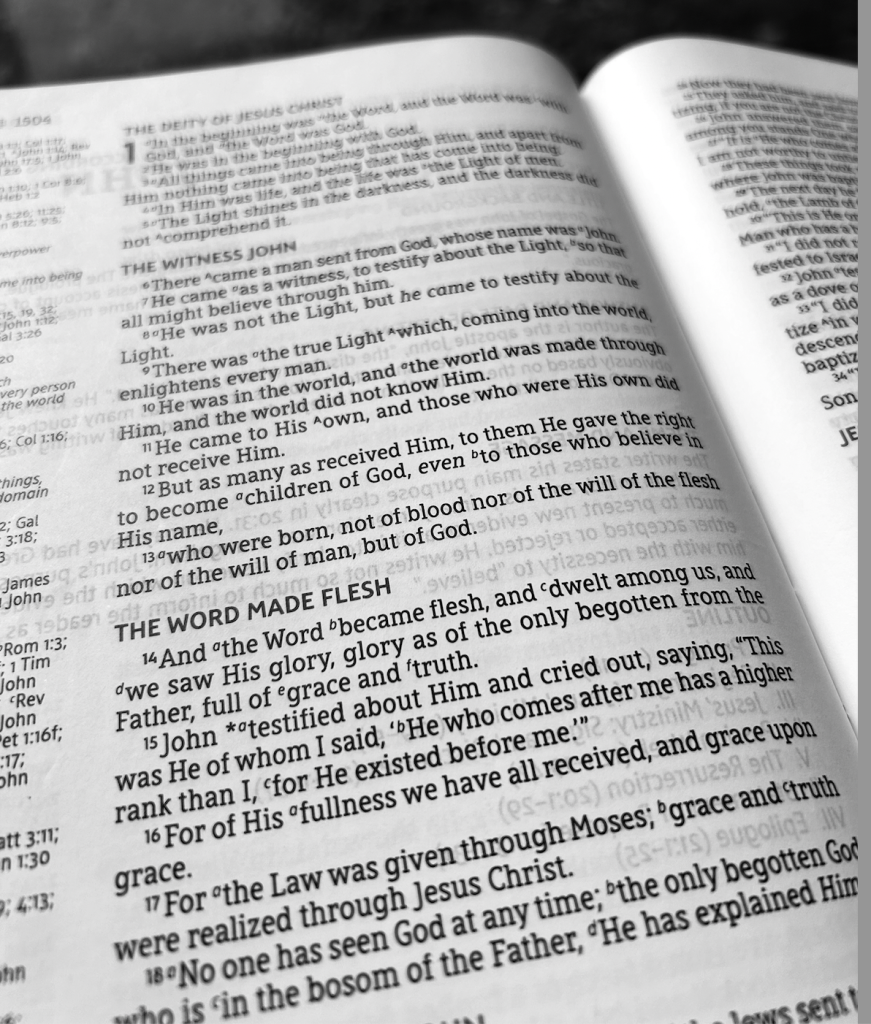
In response to this explanation, there is a Greek word that means “son,” υἱός, and choice implies meaning. We also know from the letter of Ignatius to the Romans that Greek speakers have a way to say “only son.” Writing very early in the second century, Ignatius employed the phrase Ἰησοῦ Χριστοῦ τοῦ μόνου υἱοῦ αὐτοῦ, “Jesus Christ his only son” (Ign. Rom. 1:1).17 In John 1:18, John chose to use μονογενής, “only begotten.” John did not employ υἱός, “son,” nor did he choose to write μόνος, which BDAG glosses “the only entity in a class.”18 That sounds a lot like “the only one of its kind.” In John 3:16, moreover, John chose to write the expression τὸν υἱὸν τὸν μονογενῆ “the son, the only begotten one,” showing that he does not use “son” and “only begotten” interchangeably, for if they were interchangeable, he would not use them both. In John 3:16, “only begotten” clarifies something about the son, or John could forgo the word.
John’s Gospel evidences purposeful word choice and intentional juxtaposition of particular statements. He communicates his message through literary structure and symbolism, and he has chosen every word carefully.19 Rather than rewording things with what they think are dynamic equivalents, translators should render the words the author used. When translators reword with dynamic equivalents, they take out words that are in the text (“only begotten”) and put in words that are not in the text (“son”).
Lee Irons Has Entered the Chat
Lee Irons has produced a series of studies dealing with the translation of μονογενής. In 2017 he published a lexical defense of “only begotten,” using the Thesaurus Linguae Graecae to examine the usage of the word, discussing the term’s etymology, and explaining that the concrete meaning of the term is “only begotten,” which is then metaphorically extended depending on context to mean “unique” or “only,” and concluding with contextual considerations of the meaning of the statements in John 1:14 and 1:18. Then at the 2017 annual meeting of the Evangelical Theological Society (ETS) he presented “A Cognitive Linguistic Approach” to understanding the term. This essay supports the earlier by explaining a principled polysemy that facilitates understanding of how people “start with a central meaning that is usually the earliest meaning and the most embodied, and then we see various semantic extensions that radiate outward.”20 This enables us to explain some instances of the term that mean “only begotten” while others extend that meaning metaphorically to “only one of its kind.”
At ETS in 2021 Irons presented on the meaning of the term in the pro-Nicene fathers of the fourth century. He examined how Athanasius, Eusebius of Caesarea, Cyril of Jerusalem, Gregory Nazianzen, Basil of Caeserea, and Gregory of Nyssa understood μονογενής and demonstrated that they “understood monogenēs . . . to mean ‘only born’ or ‘only begotten’ in the sense of ‘not having any siblings.’”21
In 2023 Irons again presented at ETS on μονογενής in early Latin Christianity. He summarized both the wider discussion and his own earlier work and looked particularly at Moody’s indictment of Jerome “as the culprit responsible for introducing the innovative rendering unigenitus.”22 Irons surfaced the assumptions Moody made, on which his claim about Jerome was based: first, that the Old Latin New Testament before Jerome revised it read unicus as opposed to unigenitus; and second, that unicus applied to the Son meant “unique.” Irons demonstrated that “Moody’s two assumptions are totally incorrect.”23 He presented an impressive table comparing unicus and unigenitus in Old Latin Manuscripts of the Gospel of John, in which there are 67 readings of unigenitus against only 15 of unicus. This led him to conclude that Jerome “likely received unigenitus from the Old Latin manuscripts of the Gospels known to him.”24 On Moody’s second assumption, Irons concluded, “the Latin scribes did not share Moody’s view that unicus filius and unigenitus conveyed dramatically different ideas. They saw them as essentially synonymous.”25
Most recently, in an article for the Kenwood Bulletin, Irons again updates the discussion with a summary of his own work and its reception. He celebrates the fact that what he calls “the revisionist view” has begun to crumble—the idea that μονογενής in the Johannine literature means “unique.”26 Irons proceeds to demonstrate that “‘only begotten’ is deeply rooted in the most ancient traditions of the church—the apostolic fathers (Justin Martyr and Tertullian), ante-Nicene Latin Christian translations and literature (unigenitus), the ante-Nicene church fathers (like Origen), the Nicene Creed itself, and the fourth century fathers after the Council of Nicaea.”27 He then provides a point by point assessment of the statement of the 2025 ESV translation oversight committee quoted above.28
I am in complete agreement with Irons on the point that “the reasons the RSV abandoned the Tyndale-King James legacy on μονογενής were not sound.”29 I also agree with his judgment that rendering μονογενής as “only begotten” is not only “warranted on lexical grounds, but also desirable in order to keep our English versions ‘in sync’ with the unanimous Nicene tradition.”30
I want to add exegetical and biblical-theological support to the case Irons has been making. I will begin with biblical theological considerations on “seed” and “begetting” before turning to exegetical evidence that John refers to Jesus as the “only begotten” to distinguish him from other children of God who are “begotten” in an analogous but distinguishable sense.
Biblical Theological Considerations on the Meaning of Words
Though some have used the phrase “biblical theology” in an attempt to avoid “systematic theology” (see comments on Dale Moody in note 10 above), I would define the task of biblical theology as the attempt to understand and embrace the interpretive perspective of the biblical authors.31 The attempt to understand their perspective means that we must understand what the authors intended to communicate, and to get at that we must engage in grammatical-historical interpretation in context. The grammatical piece means we seek to understand how grammatical and syntactical constructions were used to communicate meaning. The historical piece means we seek to understand how particular terms were used, what they signified, denoted, and connoted, at the time the authors chose to employ them. Because we live in a vastly different culture a long time after the biblical authors wrote, we must beware the tendency to assume that what we think is what they thought.
Consider, for instance, Dale Moody’s comment about “begetting,”
The widow’s son at Nain is called ‘the only (monogenēs) son of his mother,’ and surely no one would insist that she begat him! That, according to Webster, the Bible (Matt 1:1–16), and biology is a male function! It clearly means the only son born to her, the only one in existence, the only one she had!32
The old adage holds that when the Baptist preacher knows he has no evidence for his position he shouts louder and bangs on the pulpit. Moody does this in writing with exclamation points. If Moody’s reference to Webster points to the English dictionary, that is obviously irrelevant to this discussion. On the question of biblical usage, he appears to point to the use of the “begat” verb (ἐγέννησεν) in the genealogy in Matthew 1:1–16.
Like the genealogies in Genesis 5 and 11, the one in Matthew 1 traces the line of descent largely through the fathers. The question, however, of whether the biblical authors think of this aspect of “biology” the way Moody does—as “a male function!”—depends on whether the verb ἐγέννησεν ever describes a woman “begetting.” The Greek translation of Exodus 6:20 says the mother of Moses and Aaron, Jochebed “begat” (ἐγέννησεν, translating וַתֵּלֶד) the boys for Amram.33 The verb ילד is rendered ἐγέννησεν in the genealogies of Genesis 5 and 11. That action is not exclusively male. Though the Greek translation renders it differently, Eve “begat” a son in Genesis 4:25 (וַתֵּלֶד). Greek and English translations may render the verb ילד differently in some places (begat if the subject is male, bore if female), but the same Hebrew verb takes both male and female subjects. The Greek translators likewise use the same Greek verb, ἐγέννησεν, with both male and female subjects. This would not be the case if they held Moody’s view, that the activity is “a male function!” Even in the New Testament we read of Elizabeth in Luke 1:57, καὶ ἐγέννησεν υἱόν “and she begat a son.”
It seems that Moody based his conclusion not on the usage of the Hebrew and Greek terms in the Scriptures but on the consistent way in which those terms were translated into English. The English translations consistently distinguished their translation of the verb according to the gender of the subject. Whereas the RSV rendered ἐγέννησεν in Matthew 1:2, “Abraham was the father of Isaac” (KJV “begat”), it rendered the same verb in Luke 1:57, “and she gave birth to a son” (KJV “brought forth”). Similarly, the RSV rendered Genesis 5:3, “Adam . . . became the father of a son” (KJV “begat”), but it translated the same verb in Exodus 6:20, “Jochebed . . . and she bore him Aaron and Moses” (KJV “bare”). Moody seems to have assumed on this basis that “begetting” was “a male function!”, but this conclusion cannot be established from the usage of the relevant Greek and Hebrew verbs. The task of biblical theology is the task of understanding and embracing the way the biblical authors think about, among other things, begetting.
This example illustrates why the formal equivalent approach to translation best positions readers to do biblical theology. The more dynamic the translation choices are, the more translators reword things, the further the translation gets from the word choices made by the biblical authors as they encoded their thoughts in language.
Another example of this, and one related to “begetting,” is the term “seed.” God created seed bearing plants on the third day (Gen 1:11–13), and then God promised that the seed of the woman would crush the head of the serpent and his seed (Gen 3:15). The Hebrew language has other words for “son” (בֵּן) or “child/offspring/one borne” (וָלָד, Gen 11:30; יֶלֶד). In Genesis 3:15 Moses chose to use the term “seed” rather than some other term for a male child, and choice implies meaning.
If translators choose a “dynamic equivalent” such as “offspring” rather than the formal, literal term, “seed,” possible connections between seeds that fall into the ground, die, and bear fruit (John 12:24), and the seed of the woman, are lost.34 But the fact that plants and people yield seed helps to explain why people are so often metaphorically described as plants in the Old Testament (Ps 1; Isa 11:1; Ps 80:8; Jer 23:5, etc.). It also helps us understand why, for instance, when the Lord promises to fulfill his promise to multiply the seed of Abraham, he says he will “sow” the people in the land (Hos 2:23), and why Paul would speak of bodies being “sown/seeded” (σπείρεται) perishable to be raised imperishable (1 Cor 15:42). If these things seem foreign to us, it is because we are not thinking about seed the way the biblical authors do. But in order to think about seed the way the biblical authors do, we must examine their use of the relevant terminology. Anyone limited to an English translation needs to have the English word “seed” where the Hebrew זֶרַע or the Greek σπέρμα occur—rather than a dynamic equivalent such as “offspring” or “descendent.”
When translators render the words chosen by the biblical authors consistently, readers can see for themselves connections between the “seed” of plants and the “seed” of men, or women. This enables readers to reconstruct the imaginary, the worldview, the way of thinking, with its assumptions and givens, reflected in the words the biblical authors used to describe the world. In the biblical imaginary, people are described as “seed,” and like seed they get “sown” in the ground. The Lord keeps making promises about the “seed” through whom he will bless the world (Gen 3:15; 12:7; 13:18; 15:3–5, 18; 17:6–8; 22:17–18; 24:60; 26:3–4; 28:4; 35:9–12; 2 Sam 7:12–14, etc.).
The term “seed” has to do with begetting. Part of my point is that English translators are not thinking about “seed” the way the biblical authors are. If they were, they would insist on rendering the relevant Greek and Hebrew terms as “seed” in order to preserve connections and connotations. The fact that they have forsaken the term “seed” for dynamic equivalents like “offspring” seems to indicate that they either have not noticed the connections and connotations or do not think them significant enough to require the retention of the English “seed” in their translations.
If modern English speakers are not thinking about “seed” the way the biblical authors did, it is quite likely that we are not thinking about “begetting” the way the biblical authors did either. To understand and embrace their perspective, we have to encounter their words the way they used them.
In order to understand and embrace the interpretive perspective of the biblical authors, we must read the very words they chose. This means that the best way to pursue biblical theology is to read the text in the original language in which it was composed. Those who cannot read Hebrew, Aramaic, and Greek need direct, literal, formally equivalent translations that consistently give readers the words chosen by the biblical authors.
In the same way that the Greek term for son, υἱός, should be translated “son,” the Greek term μονογενής should be rendered “only begotten” when it used in familial contexts. This will be plain from relevant texts in John’s writings that we now turn to consider.
Exegetical Considerations on
the Only Begotten and the Others Begotten
Everything I have discussed about people being “begotten” and the involvement of “seed” in the process becomes relevant when we consider several passages in John’s Gospel and his first Epistle. We begin with John 1:13–14, before turning to 1 John 4:7–10, 3:9–10, and 5:18. Each of these texts include the verb γεννάω, so I will summarize the three points Lee Irons makes in response to the etymological concern that μονογενής derives from μόνος + γένος (kind) rather than γεννάω.35
First, Irons notes that these terms are related. They “derive from the same Indo-European root,” and that γένος “can mean ‘descendent’ (e.g., Rev 22:16). The history of the Greek language will not allow us to exclude notions of birth and generation from monogenēs on the ground that it derives from γένος or γί(γ)νομαι.”36
Second, Irons summarizes the “wealth of lexemes in Greek that are built upon the –genēs stem. The word list of TLG reveals that there are at least 145 such words in the ancient Greek vocabulary. In the vast majority of instances, the glosses given in LSJ contain such words as ‘born’ and ‘produced.’” Irons lists examples such as “sea-born,” “new-born,” and he notes that “Fewer than 12 of the 145 –genēs words involve meanings related to ‘kind’ (e.g., ὁμογενής means ‘of the same genus’).”37
Finally, and related to the words formed with the –genēs stem, Irons surveys the names likewise formed. He notes that the Lexicon of Greek Personal Names has catalogued some 36,000 names from ancient Greek literary sources, and finds “at least 166 ancient Greek proper names based on the –genēs stem.” Examples include Diogenes, “born of Zeus,” Hermogenes, “born of Hermes,” and so forth. Irons appropriately concludes, “I have reviewed the etymological evidence, not to prove that monogenēs means ‘only begotten,’ but to answer those who appeal to etymology in the attempt to prove that it cannot mean ‘only begotten.’”38 Meaning is established by usage, and Irons argues on the basis of usage that in familial contexts, monogenēs means “only begotten,” and that this is the literal, concrete meaning extended to mean “unique” or “only” in non-familial contexts, such as Moody’s nail in the coffin example of the Phoenix.39
All that we have said about etymology to this point pertains to the way that John juxtaposes γεννάω, “beget,” and μονογενής, “only begotten,” in John 1:13–14. I place the Greek text (NA28) of these verses side by side with my own literal translation to facilitate ease of reference here:
| John 1:13–14, NA28 | John 1:13–14, My Translation |
| 13 οἳ οὐκ ἐξ αἱμάτων οὐδὲ ἐκ θελήματος σαρκὸς οὐδὲ ἐκ θελήματος ἀνδρὸς ἀλλʼ ἐκ θεοῦ ἐγεννήθησαν. 14 Καὶ ὁ λόγος σὰρξ ἐγένετο καὶ ἐσκήνωσεν ἐν ἡμῖν, καὶ ἐθεασάμεθα τὴν δόξαν αὐτοῦ, δόξαν ὡς μονογενοῦς παρὰ πατρός, πλήρης χάριτος καὶ ἀληθείας. | 13 who not from bloods, nor from the will of the flesh, nor from the will of man, but from God were begotten. 14 And the word flesh became, and tabernacled among us, and we have seen his glory, glory as of the only begotten from the Father, full of grace and truth. |
In these two verses, John speaks of people who are “begotten from God” (ἐκ θεοῦ ἐγεννήθησαν) at the end of 1:13, before describing the word as “the only begotten from the Father” (μονογενοῦς παρὰ πατρός) in 1:14. Describing the word made flesh, Jesus, in these terms establishes an analogical point of contact between Jesus and those who receive him (John 1:12), who are born of God, even as these terms also distinguish Jesus from those who receive him. While John aligns both Jesus and those who receive him as begotten of the Father, he also distinguishes them by employing different prepositions and by speaking of God on the one hand and Father on the other—people who receive Jesus are “begotten ἐκθεοῦ,” from/out of God; whereas the word is the “only begotten παρὰ πατρός” from/beside the Father.40
John shows himself characteristically careful in this aligning with even as he distinguishes from: in the opening words of his Gospel he speaks of the Word being both God and with God, aligning the Word with God even as he distinguishes the Word from God. These careful theological distinctions mark John’s Gospel, but John’s precision in 1:13–14 is lost if translations render μονογενοῦς in John 1:14 merely “only” or “unique.” John seems to intend to align people who are “begotten of God” (ἐκ θεοῦ ἐγεννήθησαν) with the “only begotten from the Father” (μονογενοῦς παρὰ πατρός), even as he simultaneously distinguishes the Word from them.
The same aligning with and distinguishing from can be seen in 1 John 4:7–9. Once again I set the Greek text side by side with my own literal translation for ease of reference:
| 1 John 4:7–9, NA28 | 1 John 4:7–9, My Translation |
| 7 Ἀγαπητοί, ἀγαπῶμεν ἀλλήλους, ὅτι ἡἀγάπη ἐκ τοῦ θεοῦ ἐστιν, καὶ πᾶς ὁ ἀγαπῶν ἐκ τοῦ θεοῦ γεγέννηται καὶ γινώσκει τὸν θεόν. 8 ὁ μὴ ἀγαπῶν οὐκ ἔγνω τὸν θεόν, ὅτι ὁ θεὸς ἀγάπη ἐστίν. 9 ἐν τούτῳ ἐφανερώθη ἡ ἀγάπη τοῦ θεοῦ ἐν ἡμῖν, ὅτι τὸν υἱὸν αὐτοῦ τὸν μονογενῆ ἀπέσταλκεν ὁ θεὸς εἰς τὸν κόσμον, ἵνα ζήσωμεν διʼ αὐτοῦ. | 7 Beloved, let us love one another, because love is from God, and everyone who loves has been born from God and knows God. 8 The one who does not love does not know God, because God is love. 9 By this the love of God manifests among us, because God sent his only begotten Son into the world, that we might live through him. |
Here again those who are begotten, believers, are aligned with and distinguished from God’s only begotten Son. In this case, God sent his only begotten to manifest his love, resulting in those begotten of God loving one another. The expression of God’s love in the form of his only begotten Son results in the begetting of others who, having experienced God’s love and come to know him, love one another.
John reveals more of his thinking about the relationship between the only begotten Son of God, believers who are begotten of God, and the seed by which they are begotten in 1 John 3:9. Here again is the Greek text next to my translation:
| 1 John 3:9–10, NA28 | 1 John 3:9–10, My Translation |
| 9 Πᾶς ὁ γεγεννημένος ἐκ τοῦ θεοῦ ἁμαρτίαν οὐ ποιεῖ, ὅτι σπέρμα αὐτοῦ ἐν αὐτῷ μένει, καὶ οὐ δύναται ἁμαρτάνειν, ὅτι ἐκ τοῦ θεοῦ γεγέννηται. 10 ἐν τούτῳ φανερά ἐστιν τὰ τέκνα τοῦ θεοῦ καὶ τὰ τέκνα τοῦ διαβόλου· πᾶς ὁ μὴ ποιῶν δικαιοσύνην οὐκ ἔστιν ἐκ τοῦ θεοῦ καὶ ὁ μὴ ἀγαπῶν τὸν ἀδελφὸν αὐτοῦ. | 9 Everyone one who has been begotten from God does not practice sin, because his seed abides in him, and he is not able to practice sin, because he has been begotten from God. 10 By this the children of God and the children of the devil are manifest: everyone who does not practice righteousness is not from God, nor is the one who does not love his brother. |
In this case John does not refer to Jesus as the only begotten, but he does refer to him as God’s seed.41 John spoke of the Son of God appearing to destroy the works of the devil in 3:8, and that destruction of the works of the devil fulfills God’s Genesis 3:15 promise that the seed of the woman would bruise the serpent’s head. Jesus also promised that he would abide in those who received him (John 6:56; 15:4, 5). Jesus is the seed the woman—the one who descends from Adam, Abraham, Judah, and David (Gen 3:15; 22:17–18; 49:8–12; 2 Sam 7:12), and he is the seed that falls into the ground and dies to bear fruit (Gen 1:11–13; John 12:24). In keeping with this imagery, he is the fulfillment of the Lord’s own planting (Ps 80:8; Isa 5:1–7), the true vine (John 15:1). Those who receive him, the seed, are begotten of God (John 1:12–13) and experience the new birth (3:3–8) because they have been born again by the imperishable seed of the word of God through faith in Christ by the power of the Spirit (1 Pet 1:23). Having experienced the new birth, they abide in Christ by abiding in his word (John 8:31), and he, the seed, abides in them (15:4–5; 1 John 3:9). By means of the only begotten Son of God, those who are begotten become children of God (1 John 3:10). As Christ abides in them, they abide in his love as he abides in the Father’s love (John 15:10), and they love those who are begotten (1 John 3:10), the brethren.
Jesus is the only begotten Son of God, and believers are begotten of God. These “begettings” are analogous but not univocal, and they partake of concepts communicated through the terms chosen by the biblical authors. For readers of the Bible to understand the concepts, they must be given the terms the biblical authors used. If a translation renders a word like μονογενής as “son” instead of “only begotten,” the translation has destroyed the connection between Jesus as the only begotten and believers as those begotten of God, a connection present not only in John 1:13–14 but also in 1 John 5:18. Here again is the Greek text of 1 John 5:18 next to my translation:
| 1 John 5:18, NA27 | 1 John 5:18, My Translation |
| 18 Οἴδαμεν ὅτι πᾶς ὁ γεγεννημένος ἐκ τοῦ θεοῦ οὐχ ἁμαρτάνει, ἀλλ᾽ ὁ γεννηθεὶς ἐκ τοῦ θεοῦ τηρεῖ αὐτόν καὶ ὁ πονηρὸς οὐχ ἅπτεται αὐτοῦ. | 18 We know that everyone who has been begotten from God does not practice sin, but the one who was begotten from God protects him and the evil one does not touch him. |
I have presented the text of the twenty seventh edition of the Nestle-Aland Greek New Testament above, rather than that of the twenty eighth, which reads, ὁ γεννηθεὶς ἐκ τοῦ θεοῦ τηρεῖ ἑαυτὸν, “the one who was begotten from God protects himself.” Metzger wrοte in his Textual Commentary,
The committee understood ὁ γεννηθείς to refer to Christ, and therefore adopted the reading αὐτόν, which is supported by A* B 330 614 itr vg syrh copbo al. Copyists who took ὁ γεννηθείς to refer to the Christian believer (although elsewhere John uses ὁ γεγεννημένος, never ὁ γεννηθείς, of the believer) naturally preferred the reflexive ἑαυτόν (א Ac K P Ψ 33 81 1739 al).42
The apparatus for the NA28 does not provide a full citation of the evidence, so it is difficult to assess the reason for the change. Perhaps they have opted for the more difficult reading that would explain the other. A. T. Robertson, however, commented,
He that was begotten of God (ὁ γεννηθεις ἐκ του θεου [ho gennētheis ek tou theou])… referring to Christ, if the reading of A B is correct (τηρει αὐτον [tērei auton], not τηρει ἑαυτον [tērei heauton]). It is Christ who keeps the one begotten of God (γεγεννημενος ἐκ του θεου [gegennēmenos ek tou theou] as in 3:9 and so different from ὁ γεννηθεις [ho gennētheis] here). It is a difficult phrase, but this is probably the idea. Jesus (John 18:37) uses γεγεννημαι [gegennēmai] of himself and uses also τηρεω [tēreō] of keeping the disciples (John 17:12, 15; Rev. 3:10).43
This passage fits with the others we have surveyed here (John 1:13–14, 1 John 4:7–9, and 1 John 3:9–10) where John speaks of both Jesus and believers as “begotten” of God. Even as he does this to align believers with Jesus, John also distinguishes Jesus by referring to him as the “only begotten from the Father” (John 1:14). The two distinct forms in 1 John 5:18 (πᾶς ὁ γεγεννημένος, “everyone who has been begotten,” and ὁ γεννηθεὶς, “the one who was begotten”), the one referring to many people, the other to one person in particular, would seem to distinguish these from one another, in keeping with the reading αὐτόν (him, against the reading ἑαυτόν, himself).
I note that the case I am making here does not stand or fall on 1 John 5:18. If the NA28 is correct, this text speaks of believers as being begotten, which still aligns them with God’s only begotten Son. If the NA27 is correct, 1 John 5:18 not only aligns believers as begotten with the only begotten Son of God, it also aligns them with and distinguishes them from him in the span of a few words, as John did in John 1:13–14 and 1 John 4:7–9.44
Conclusion
Lee Irons has demonstrated that the lexical meaning of μονογενής in the Johannine literature is “only begotten,”45 and he has shown that this is the way the church fathers working in both Greek and Latin understood the term.46 He has also convincingly argued that English translations should preserve “only begotten” to remain “in sync with the Nicene faith so that there is concord between our English Bible and the traditional Trinitarian understanding of Christ as the only begotten Son of God.” This is not “a private interpretation but has creedal authority.”47
In this essay I have attempted to advance the work Irons has done by summarizing and assessing the claims made by Dale Moody in his influential article.48 Against the assumptions Moody made on the basis of English translations, we have seen the necessity of thinking through the terms and phrases employed by the biblical authors to get at their interpretive perspective. In order for translators to put readers of the English Bible in position to do this, they must practice formal rather than dynamic equivalence in their renderings. The exegetical evidence from John’s Gospel and first Epistle demonstrates this point. John speaks of “seed” and “begetting” and the “only begotten” in particular ways, informed by the use of these terms and concepts in the Old Testament. Translators can help those who do not have access to the texts in the original languages by providing consistent renderings of the words John chose rather than paraphrases that remove the words he used and replace them with terms he did not use.
English translations should return to “only begotten” as the default rendering of μονογενής when it is used in familial contexts. In my opinion, they cannot do this quickly enough. The evidence from the usage of the Greek language at the time John wrote, from the history of the interpretation of his writings, from exegetical and biblical-theological consideration of what he wrote, and from the orthodox systematic theology reflected in the historic creeds demands this conclusion: for an English translation to be faithful, it must render μονογενής as “only begotten.”49
Footnotes
- Charles Lee Irons, “The Jonannine Monogenēs: A Cognitive Linguistic Approach,” November 17, 2017, 7. Charles Lee Irons, “Unique, Only Son, or Only Begotten? Translating Mονογενής,” Kenwood Bulletin 1 (2025): 23–24. ↩︎
- Dale Moody, “God’s Only Son: The Translation of John 3:16 in the Revised Standard Version,” Journal of Biblical Literature 72, no. 4 (1953): 213–19. ↩︎
- In addition to the two cited in note 1 above, these are Charles Lee Irons, “A Lexical Defense of the Johannine ‘Only Begotten,’” in Retrieving Eternal Generation, ed. Fred Sanders and Scott R. Swain (Zondervan, 2017); Charles Lee Irons, “Monogenēs as ‘Only Begotten’ in the Pro-Nicene Fourth-Century Fathers,” November 16, 2021, 1–17; and Charles Lee Irons, “‘Only Begotten’ in Early Latin Christianity,” November 14, 2023, 1–16. ↩︎
- Discussion of Hebrews 11:17 is beyond the scope of this project, but in response to those like D. A. Carson, who note that Abraham sired Ishmael and the children of Keturah, I observe that the author of Hebrews points to Isaac as the “only begotten” son of Abraham by Sarah (whom he describes as “receiving power for the foundation of the seed” in 11:11), and that the narrative of Genesis presents God himself insisting that Isaac is the seed through whom blessing will come (e.g., Gen 17:18–21). Paul also read Genesis this way (Rom 9:7–9; Gal 4:21–31). Isaac is Abraham’s only begotten son in every sense that matters. For Carson’s objection, see D. A. Carson, Exegetical Fallacies, 2nd ed. (Baker, 1996), 31. ↩︎
- Moody, “God’s Only Son.” ↩︎
- Moody, “God’s Only Son,” 213. ↩︎
- Walter Bauer, A Greek-English Lexicon of the New Testament and Other Early Christian Literature, 3rd ed., ed. Frederick William Danker, trans. W. F. Arndt and F. W. Gingrich (University Of Chicago Press, 2001), 658. ↩︎
- Carson, Exegetical Fallacies, 30–31. ↩︎
- I do not want to respond point for point to Moody’s presentation of the evidence, but one instance will illustrate why I am suspicious of the way the evidence is treated in the article. To read Moody, one would think that every lexicon supports his case, as though the authorities overwhelmingly acknowledge his thesis. Moody tosses in a reference to the TDNT article, and his framing of it—what precedes and follows—would lead the reader to think that here too the obvious meaning is “only” or “unique” and not “only begotten.” When one actually looks, however, at the article Moody cites, one finds this statement: “It means ‘only-begotten.’” On re-reading Moody, he does not claim otherwise about the article, but the first reading of that section of his study certainly gave the impression that all the authorities agree with him. I suspect that he deliberately sought to create this impression for those reading quickly, carefully avoiding the overt statement so that he could plausibly deny having claimed that TDNT supported his cause. See Friedrich Büchsel, “Μονογενής,” in Theological Dictionary of the New Testament, ed. Gerhard Kittel, Geoffrey W. Bromiley, and Gerhard Friedrich (Grand Rapids, MI: Eerdmans, 1964–), 739. ↩︎
- For a fascinating, and revealing, reflection on Moody from a sympathetic perspective, see E. Glenn Hinson, “Dale Moody: Bible Teacher Extraordinaire,” Perspectives in Religious Studies 14, no. 4 (1987): 3–17. Hinson wrote that Moody “accepted modern historical-critical methodology in study of the Bible,” noting that Moody commented, “Adjustment of biblical faith to modern science is not as catastrophic as many imagine” (5). Moody’s perspective on systematic theology can also be discerned from Hinson’s reference to one of Moody’s books as “a systematizing of what Moody would call ‘Bible doctrines’ rather than a systematic theology” (4), explaining that Moody “shifted increasingly in the direction of biblical theology taught under the rubric of systematic theology” (10). The kind of biblical theology as systematic theology practiced by Moody was informed by Eichrodt, Cullmann, Brunner, and Barth (ibid.). It also seems characteristic of Moody that when he was charged with holding a position in violation of the doctrinal statement of the school where he taught, The Southern Baptist Theological Seminary’s Abstract of Principles, he had the cheek to allege that the problem went back to “a scribal error first made by the Elder William Collins of Petty France Church in London when he revised the Westminster Confession of Faith in preparing the Second London Confession in 1677.” Moody alleged that “When the Abstract of Principles was adopted in 1858, it remained uncorrected. The Elder Collins substituted ‘they will be renewed again unto repentance’ for ‘it is impossible to renew them again to repentance’ of Hebrews 6:6” (14). Whatever Moody’s objections, the Abstract maintains the perseverance of the saints. Moody did not hold that position, so in disregard of the fact that the people who adopted the Abstract believed in perseverance, Moody made an insinuation about a scribal error that goes back to the Confession on which the Abstract was based. Impressive as are his self-confidence, resourcefulness, and bluster, this claim is an irrelevant red herring. Those who adopted the Abstract held to perseverance, and Moody did not. He was honor bound to teach in accordance with and not contrary to the Abstract, and he did not. ↩︎
- Moody, “God’s Only Son,” 214. ↩︎
- On the Old Latin Versions, Jerome’s education, and his impressive proficiency, see Benjamin Kedar, “The Latin Translations,” in Mikra: Text, Translation, Reading & Interpretation of the Hebrew Bible in Ancient Judaism & Early Christianity, ed. Martin Jan Mulder, Compendia Rerum Iudaicarum Ad Novum Testamentum (Hendrickson, 2004). Kedar writes, “Jerome’s seriousness and philological precision in reading the Hebrew text finds its expression when he is ready to forgo a christological interpretation of a verse because one silent letter is in the way . . .” (316). Illustrating Jerome’s command of the languages, Kedar notes, “Jerome inadvertently demonstrates that he is able to find easily a Hebrew equivalent for a given Greek word whenever, in correcting the wording found in the LXX, he states what the Hebrew vocable, not found in the MT, should have been, were the LXX correct” (317). And later, “Jerome preached Christian virtues and led the life of an ascetic yet he displayed a malicious disposition towards his many adversaries among whom he counted intimate friends of days past” (319). Kedar also speaks of “the vast learning of the man” (319). ↩︎
- Moody, “God’s Only Son,” 215, 216. ↩︎
- Moody, “God’s Only Son,” 213. ↩︎
- “Christian Book Expo: ECPA Bible Translations Bestsellers, February 2025,” accessed May 20, 2025, https://christianbookexpo.com/bestseller/translations.php?id=0225. ↩︎
- Crossway, “ESV Bible Translation Update,” Crossway, February 11, 2025, www.crossway.org/articles/esv-bible-translation-update. Accessed May 20, 2025. ↩︎
- Michael W. Holmes, ed., The Apostolic Fathers: Greek Texts and English Translations, 3rd ed. (Baker, 2007), 224. I wish to thank John Babuka for drawing my attention to this phrase in Ignatius. ↩︎
- Bauer, A Greek-English Lexicon of the New Testament and Other Early Christian Literature, 658. ↩︎
- See further James M. Hamilton Jr., In the Beginning Was the Word: Finding Meaning in the Literary Structure of the Gospel of John (Baker, 2025). ↩︎
- Irons, “The Jonannine Monogenēs: A Cognitive Linguistic Approach,” 9. ↩︎
- Irons, “Monogenēs as ‘Only Begotten’ in the Pro-Nicene Fourth-Century Fathers,” 17. ↩︎
- Irons, “‘Only Begotten’ in Early Latin Christianity,” 3. ↩︎
- Irons, “‘Only Begotten’ in Early Latin Christianity,” 4. ↩︎
- Irons, “‘Only Begotten’ in Early Latin Christianity,” 6. ↩︎
- Irons, “‘Only Begotten’ in Early Latin Christianity,” 9. ↩︎
- Irons, “Unique, Only Son, or Only Begotten? Translating Mονογενής,” 26–30. ↩︎
- Irons, “Unique, Only Son, or Only Begotten? Translating Mονογενής,” 30. ↩︎
- Irons, “Unique, Only Son, or Only Begotten? Translating Mονογενής,” 36–40. ↩︎
- Irons, “Unique, Only Son, or Only Begotten? Translating Mονογενής,” 40. ↩︎
- Irons, “Unique, Only Son, or Only Begotten? Translating Mονογενής,” 38. I did not grow up in a church context that regularly recited the creeds of the faith, and I have become convinced that the failure to do so impoverishes Christians. Since 2009 I have served as the senior pastor at Kenwood Baptist Church, and we have been reciting the Apostles’ Creed in worship since around 2010. After the 2016 Trinity controversy, we began to recite the Nicene Creed as well, and since 2022 we have been rotating through the Apostles’, Nicene, and Athanasian Creeds, breaking the Athanasian into three parts, so that it takes us three Sundays to get through the whole, and five Sundays to rotate through the three creeds. I note that “only begotten” appears in both Apostles’ and Nicene, and the begetting of the Son is prominent in Athanasian. The more familiar one becomes with the creeds, the more out of step with the tradition one perceives modern English translations that drop “only begotten” to be. ↩︎
- James M. Hamilton Jr., What Is Biblical Theology? (Crossway, 2014). ↩︎
- Moody, “God’s Only Son,” 216–17. ↩︎
- See also Judges 11:1, where the Greek translation makes the harlot the subject of the verb though the Hebrew text has Gilead as its subject: ἣἐγέννησεν τῷ Γαλααδ τὸν Ιεφθαε “She begat Jephthah for Gilead.” ↩︎
- See Thomas J. Sculthorpe, “Why Does Moses Call the Promised Savior a ‘Seed’? Resurrection Typology in Genesis 1–3,” Kenwood Bulletin 1 (2025): 41–61. ↩︎
- D. A. Carson raises this issue as part of his argument that translating μονογενής as “only begotten” is an exegetical fallacy. Carson, Exegetical Fallacies, 30–31. ↩︎
- Irons, “A Lexical Defense of the Johannine ‘Only Begotten,’” 103–4. ↩︎
- Irons, “A Lexical Defense of the Johannine ‘Only Begotten,’” 104. ↩︎
- Irons, “A Lexical Defense of the Johannine ‘Only Begotten,’” 105. ↩︎
- Moody ends his article quoting 1 Clement XXV.2, “There is a bird which is called the Phoenis. This being the only one of its kind (monogenēs) lives 500 years.” With his favorite punctuation mark, Moody concludes, “Now the Phoenix was neither born nor begotten, but it could be monogenēs, the only one of its kind!” Moody, “God’s Only Son,” 219. In this case, the term has been used in a non-familial context, and the concrete meaning “only begotten” has been metaphorically extended to “unique.” ↩︎
- A friend and colleague who is a systematic theologian pointed out to me in private correspondence, “The fact that believers are begotten of God and the “only begotten” is from the Father demonstrates the distinction between common divine operations and personal divine operations. The doctrine of inseparable operations states that every work of God ad extra is a work of all three persons. The only truly exclusive divine operations are those that eternally establish the relations between the persons. You and I, being creatures, cannot be begotten of the Father exclusively. We are begotten of God (a name common to the three persons). Jesus, however, as eternal divine Son, is begotten of the Father exclusively.” ↩︎
- Without a biblical theological understanding of “seed,” “begetting,” and the way John claims OT fulfillment here, commentators are left rather confused. Consider Thompson’s comments, for instance: “John continues with the explanatory statement that they cannot sin because God’s seed remains in [them]. Exactly what this seed is does not receive further explanation, and it has puzzled commentators. Obviously we must take it here in a metaphorical sense. Some have suggested that it means the Holy Spirit; others, the Word of God; and others, that it means both. Perhaps, however, it does not so much symbolize something else, but merely continues the family imagery. As Kysar writes, “God has implanted in Christians that which makes them his children” (Kysar 1986:81; Brown 1982:411; Stott 1988:133–34). And that God’s seed remains points to the permanence of that work. The seed that God plants cannot be uprooted.” Marianne Meye Thompson, 1–3 John, The IVP New Testament Commentary Series (Downers Grove, IL: InterVarsity Press, 1992), 1 Jn 3:9. ↩︎
- Bruce Metzger, A Textual Commentary on the Greek New Testament, 2nd ed. (Deutsche Biblegesellschaft, United Bible Societies, 1994), 650. ↩︎
- A. T. Robertson, Word Pictures in the New Testament (Nashville, TN: Broadman Press, 1933), 1 Jn 5:18. ↩︎
- In his recently released textual commentary, Houghton seems ambivalent, “Given the sharp contrast between internal and external evidence, it is not easy to establish the earliest text. Whichever reading is chosen, the genealogical coherence is perfect for the reflexive but not for the other reading. On this occasion SBLGNT has αὐτόν (with UBS4), while the THGNT prefers ἑαυτόν.” H. A. G. Houghton, A Textual Commentary on the Greek New Testament (UBS6): A Companion to the 6th Edition of the United Bible Societies’ Greek New Testament (German Bible Society, 2025), 366. ↩︎
- Irons, “A Lexical Defense of the Johannine ‘Only Begotten’”; Irons, “The Jonannine Monogenēs: A Cognitive Linguistic Approach.” ↩︎
- Irons, “Monogenēs as ‘Only Begotten’ in the Pro-Nicene Fourth-Century Fathers”; Irons, “‘Only Begotten’ in Early Latin Christianity.” ↩︎
- Irons, “Unique, Only Son, or Only Begotten? Translating Mονογενής,” 38, 33. ↩︎
- Moody, “God’s Only Son.” ↩︎
- I wish to thank Brian Vickers, Tom Sculthorpe, Kyle Claunch, Tom Schreiner, John Babuka, Lee Irons, and Denny Burk for reading this essay and offering valuable feedback. ↩︎

Jim Hamilton is Professor of Biblical Theology at The Southern Baptist Theological Seminary and the senior pastor of Kenwood Baptist Church at Victory Memorial in Louisville, KY. His published works include What Is Biblical Theology?, God’s Glory in Salvation Through Judgment: A Biblical Theology, and Typology: Understanding the Bible’s Promised-Shaped Patterns.
Share This